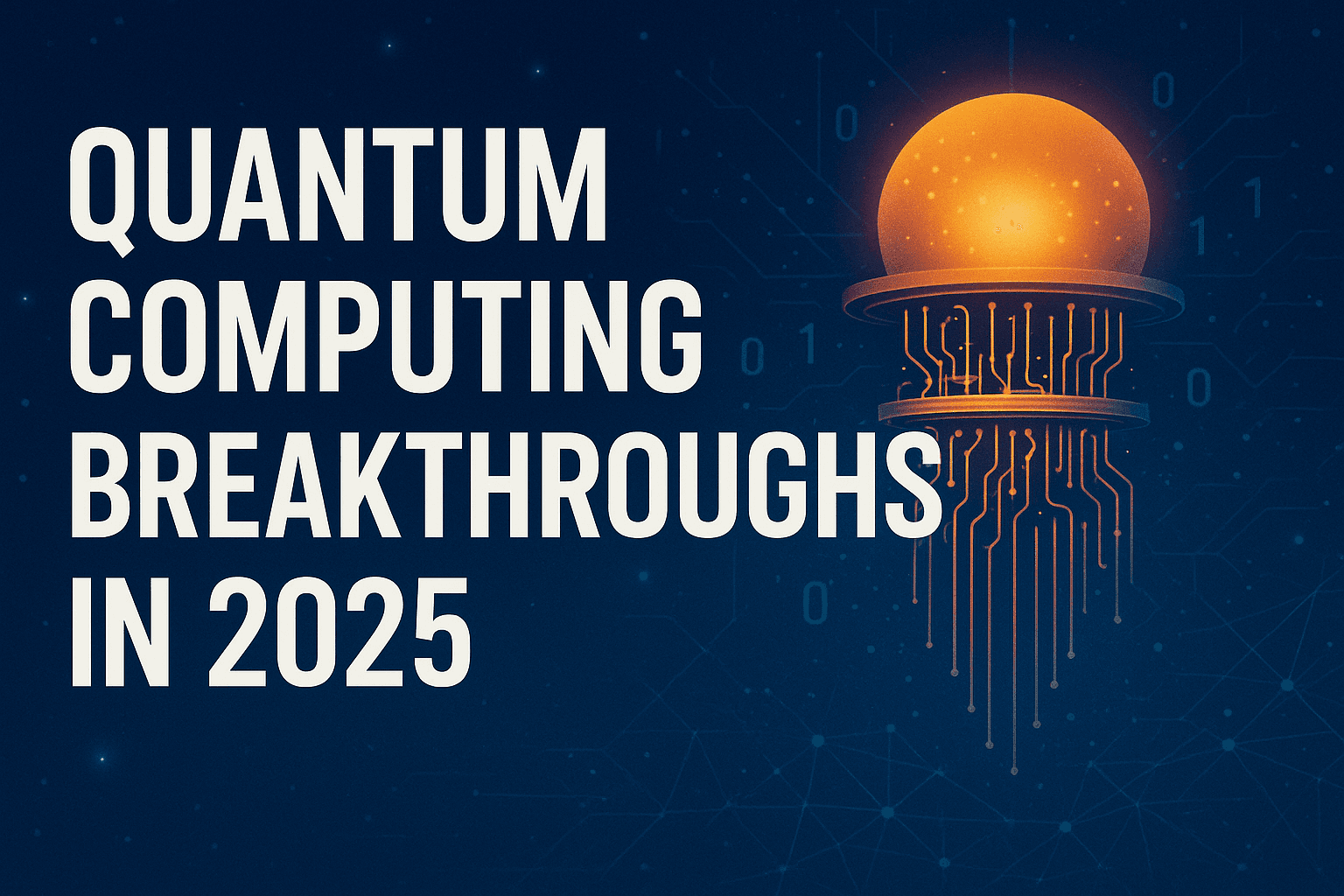
Quantum Computing Breakthroughs in 2025

Written by Uzair Khan · Founder & Editor
Uzair Khan is the founder of ukbloge, a US-focused publication covering home improvement, personal finance, real estate, and technology. The site name comes from his initials (U.K.). He researches and edits guides to help American readers make confident decisions about their homes, money, and tech.
Quantum Computing in 2025: What It Means for US Workers and Students
Quantum computers will not replace your laptop—but they are moving from physics lectures to **cloud access** for researchers and companies. IBM, Google, Amazon Braket, and US national labs offer queue time on quantum processors. Here is a grounded explainer for curious Americans.
What Quantum Computers Do Differently
Classical bits are 0 or 1. **Qubits** use quantum properties to explore many solutions simultaneously—for specific math problems: molecular simulation, optimization, cryptography research.
They are terrible at email, Word documents, and Netflix.
Real US Applications Today (Early Stage)
- **Pharmaceutical research:** Modeling molecules (partnerships with US pharma and DOE labs)
- **Logistics optimization:** Shipping and airline routing experiments
- **Financial risk simulation:** Banks exploring tail-risk models—still experimental
- **Cryptography:** NSA and NIST prepare for **post-quantum cryptography** standards—US agencies migrating over coming years
Error Correction: Why Scale Is Hard
Qubits are fragile. **Quantum error correction** is the 2020s race—thousands of physical qubits needed for one reliable logical qubit. Progress is real but slow compared to smartphone hype cycles.
Career Paths for US Students
Quantum roles need strong **linear algebra, probability, and programming** (Python, Qiskit, Cirq). Degrees in physics, EE, and CS lead in—not "quantum certificates" alone.
Universities with quantum programs: MIT, Caltech, UChicago, Maryland, and others; many offer free online intros (IBM Qiskit textbook).
Should You Invest in "Quantum Stocks"?
Public companies touch quantum (IBM, Google parent Alphabet, IonQ, Rigetti). Speculative, volatile, revenue often minimal from quantum specifically. Treat as high-risk slice of portfolio if at all—not a retirement core holding.
US Government and University Access
Quantum Economic Development Consortium (QED-C)
Timeline Expectations
Household quantum computers are not on a 5-year consumer roadmap. Investment and career planning should treat quantum as **infrastructure and research**, similar to fusion energy—progress real, products distant for daily life.
Classroom and Online Learning Paths
IBM Qiskit
Ethics and Encryption Timeline
NIST post-quantum standards migration is multi-year US federal project—commercial websites gradually adopt. Consumers need not change passwords because of quantum tomorrow; follow browser and OS updates for cryptographic agility long term.
Patent and IP Landscape
US companies file thousands of quantum patents—career in IP law specializing quantum growing. Engineers should document inventions if employed—assignment agreements common at IBM, Google, startups.
Popular Science vs Research Papers
Read **Quanta Magazine** and **APS Physics** summaries before arXiv preprints—US media sometimes overhypes qubit counts without error correction context.
University and National Lab Tours
Some US national labs offer public lectures on quantum (Fermilab, SLAC)—not hands-on qubits but accurate context. High school science fairs increasingly include quantum-themed projects—resources from IBM Qiskit camp curriculum free online.
Avoiding Quantum Investment Scams
US SEC warns about "quantum stock" pump schemes on social media. If pitch promises guaranteed returns from pre-revenue quantum startups, report to SEC tips line. Legitimate exposure for retail investors remains ETFs and established tech giants with research divisions—not obscure OTC tickers.
Conclusion
Quantum computing matters for US science, defense, and long-term cryptography—not consumer gadgets in 2025. Follow NIST post-quantum migration for cybersecurity; ignore get-rich-quick quantum hype. ### Sources and Further Reading
- FCC Consumer Help Center: fcc.gov/consumers
- FTC — Technology issues: consumer.ftc.gov/technology
- CISA — Secure by design: cisa.gov/securebydesign